A Brief Introduction to Motivation Theory
A concise map of the major theories of motivation in management — Maslow, Alderfer, Herzberg, McClelland, Vroom, Locke and Adams — organised into content and process perspectives.
Note. This is the original article first published here in February 2011 and cited by Wikipedia as a reference on motivation theory. It is preserved in its original form.
What is Motivation?
Motivation is the answer to the question "Why we do what we do?". The motivation theories try to figure out what the "M" is in the equation: "M motivates P" (Motivator motivates the Person). It is one of the most important duties of an entrepreneur to motivate people. (I strongly believe that motivating people with visionary and shared goals is more favorable than motivating through tactics, incentives or manipulation through simple carrot-and-stick approaches, because motivating with vision is natural whereas the former is artificial and ephemeral.)
Now, let's rise on the shoulders of the giants:
A Classification of Motivation Theories (Content vs. Process)
Motivation theories can be classified broadly into two different perspectives: Content and Process theories. Content theories deal with "what" motivates people and are concerned with individual needs and goals. Maslow, Alderfer, Herzberg and McClelland studied motivation from a "content" perspective. Process theories deal with the "process" of motivation and are concerned with "how" motivation occurs. Vroom, Porter & Lawler, Adams and Locke studied motivation from a "process" perspective.
1. Content Theories about Motivation
Abraham Maslow's Hierarchy of Needs
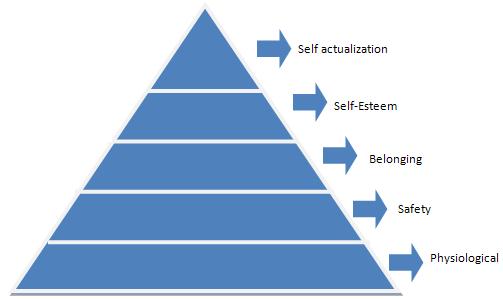
When motivation theory is being considered, the first theory that is recalled is Maslow's hierarchy of needs, which he introduced in his 1943 article named "A Theory of Human Motivation". According to this theory, the individual strives to seek a higher need when lower needs are fulfilled. Once a lower-level need is satisfied, it no longer serves as a source of motivation. Needs are motivators only when they are unsatisfied.
- In the first level, physiological needs exist, which include the most basic needs for humans to survive, such as air, water and food.
- In the second level, safety needs exist, which include personal security, health, well-being and safety against accidents.
- In the third level, belonging needs exist. This is where people need to feel a sense of belonging and acceptance. It is about relationships, families and friendship. Organizations fulfill this need for people.
- In the fourth level, self-esteem needs remain. This is where people look to be respected and to have self-respect. Achievement needs and the respect of others are in this level.
- In the top level, self-actualization needs exist. This level of need pertains to realising the person's full potential.
Alderfer's ERG Theory
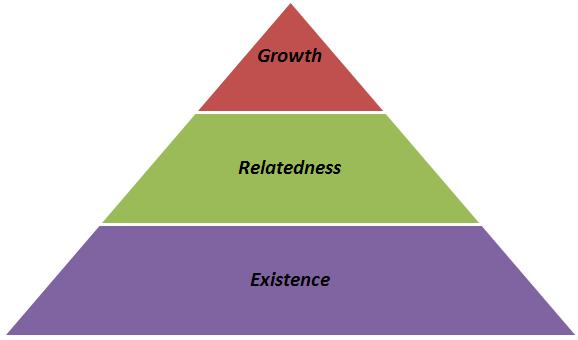
In 1969, Clayton P. Alderfer simplified Maslow's theory by categorizing the hierarchy of needs into three categories:
- Physiological and safety needs are merged into Existence Needs.
- Belonging needs are named Relatedness Needs.
- Self-esteem and self-actualization needs are merged into Growth Needs.
Herzberg's Two Factor Theory

Frederick Herzberg introduced his Two Factor Theory in 1959. He suggested that there are two kinds of factors that affect motivation, and they do it in different ways:
1) Hygiene factors: A series of hygiene factors create dissatisfaction if individuals perceive them as inadequate or inequitable, yet individuals will not be significantly motivated if these factors are viewed as adequate or good. Hygiene factors are extrinsic and include factors such as salary or remuneration, job security and working conditions.
2) Motivators: They are intrinsic factors such as a sense of achievement, recognition, responsibility, and personal growth.
The hygiene factors determine dissatisfaction, and motivators determine satisfaction. Herzberg's theory conforms with satisfaction theories which assert that "a satisfied employee tends to work in the same organization, but this satisfaction does not always result in better performance". In other words, satisfaction does not correlate with productivity.
McClelland's Achievement Need Theory
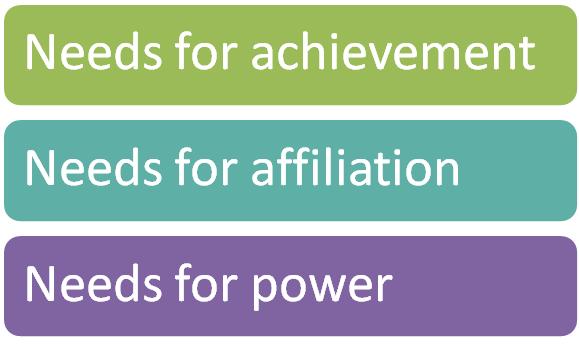
In his 1961 book named "The Achieving Society", David McClelland identified three basic needs that people develop and acquire from their life experiences.
- Need for achievement: The person who has a high need for achievement seeks achievement and tries to attain challenging goals. There is a strong need for feedback as to achievement and progress, and a need for a sense of accomplishment. The person who has a high achievement need likes to take personal responsibility.
- Need for affiliation: The person who has a high need for affiliation needs harmonious relationships with people and needs to be accepted by other people. (People-oriented rather than task-oriented.)
- Need for power: The person who has a need for power wants to direct and command other people. Most managers have a high need for power.
Although these categories of needs are not exclusive, generally individuals develop a dominant bias or emphasis towards one of the three needs. Entrepreneurs usually have a high degree of achievement needs.
Incentive Theory
Incentive theory suggests that an employee will increase her/his effort to obtain a desired reward. This is based on the general principle of reinforcement. The desired outcome is usually "money". This theory is coherent with the early economic theories where man is supposed to be rational and forecasts are based on the principle of the "economic man".
2. Process Theories about Motivation
Expectancy Theory
Expectancy theory argues that humans act according to their conscious expectations that a particular behavior will lead to specific desirable goals.
Victor H. Vroom developed the expectancy theory in 1964, producing a systematic explanatory theory of workplace motivation. The theory asserts that the motivation to behave in a particular way is determined by an individual's expectation that the behaviour will lead to a particular outcome, multiplied by the preference or valence that the person has for that outcome.
The three components of expectancy theory are:
- Expectancy: E → P. The belief of the person that her/his effort (E) will result in attainment of the desired performance (P) goals.
- Instrumentality: P → R. The belief of the person that she/he will receive a reward (R) if the performance (P) expectation is met.
- Valence: The value of the reward according to the person. (e.g. Is the reward attractive to the person?)
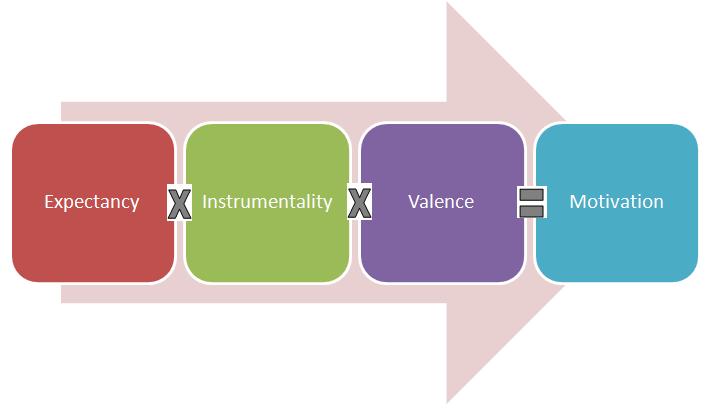
The equation suggests that human behaviour is directed by subjective probability.
Goal Theory
Edwin Locke proposed Goal Theory in 1968, which proposes that motivation and performance will be high if individuals are set specific goals which are challenging, but accepted, and where feedback is given on performance.
The two most important findings of this theory are:
- Setting specific goals (e.g. "I want to earn a million before I am 30") generates higher levels of performance than setting general goals (e.g. "I want to earn a lot of money").
- Goals that are hard to achieve are linearly and positively connected to performance. The harder the goal, the more a person will work to reach it.
Adams' Equity Theory
Developed by John Stacey Adams in 1963, Equity Theory suggests that if the individual perceives that the rewards received are equitable — that is, fair or just in comparison with those received by others in similar positions in or outside the organization — then the individual feels satisfied. Adams asserted that employees seek to maintain equity between the inputs that they bring to a job and the outcomes that they receive from it, against the perceived inputs and outcomes of others.