Organizational Effectiveness
What constitutes organizational effectiveness and how to measure it — Robbins, Etzioni, Daft's three contingency approaches, and the Competing Values Framework of Quinn and Rohrbaugh.
Originally published in May 2011 on Dr. Özgür Zan's original management blog, and preserved here in its original form.
In organizational effectiveness research, there is little consensus emerged, either theoretically or empirically, as to what constitutes organizational effectiveness and how best to measure it. Robbins asserts that effectiveness, like beauty, is in the eye of the beholder. Different groups (Stakeholders) judge organizations by different criteria.
According to Etzioni organizational effectiveness is the degree to which an organization realizes its goals. Etzioni considers “organizational effectiveness” another name for “goal achievement”.
Daft defines three contingency approaches to the measurement of organizational effectiveness:
1-Resource based approach assesses effectiveness by observing the beginning of the process and evaluating whether the organization effectively obtains resources necessary for high performance. Organizational effectiveness is defined as the ability of the organization to obtain scarce and valued resources. Ex: Low cost inputs, high quality raw materials. (In many not-for-profit organizations it is hard to measure output goals or internal efficiency.)
2-Internal process approach looks at the internal activities. Organizational effectiveness is measured as internal organizational health and efficiency. Ex: strong corporate culture.
3-Goal approach is concerned with the output side and whether the organization achieves its goals in terms of desired levels of output. Since organizations have multiple and conflicting goals, effectiveness cannot be assessed by a single indicator. Ex: operative goals.
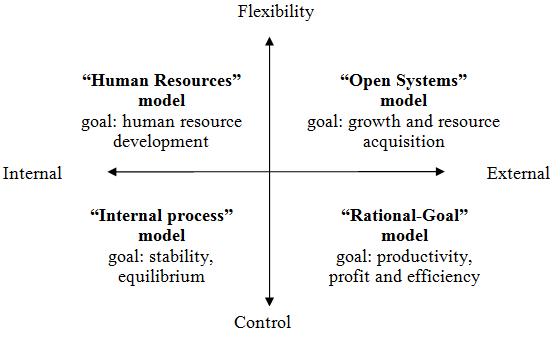
The “Competing Values Framework” of Quinn and Rohrbaugh (1983) is a theory derived from research conducted on major indicators of effective organizations. Based on statistical analyses of a comprehensive list of effectiveness indicators, they discovered two major dimensions underlying the conceptions of effectiveness.
First dimension is related to organizational focus. Internal emphasis is on the well being and development of the people in the organization. External emphasis is on the well being and development of the organization itself with respect to its environment.
Second dimension is related to preference for structure and represents the contrast between “stability and control” and “change and flexibility”.
-
Human Resources model emphasizes flexibility and internal focus and stresses cohesion, morale, and human resources development as criteria for effectiveness
-
Open Systems model emphasizes flexibility and external focus and stresses readiness, growth, resource acquisition and external support
-
Rational goal model emphasizes control and external focus and stresses planning, goal setting, productivity, efficiency as the criteria for effectiveness
-
Internal process model emphasizes control and internal focus and stresses role of information management, communication, stability and control
For a brief introduction to organization theory please click.