Division of Labor (Adam Smith)
Adam Smith on the division of labour — the pin factory, the three causes of increased output, and the famous 'invisible hand' in his own words from The Wealth of Nations.
Originally published in January 2011 on Dr. Özgür Zan's original management blog, and preserved here in its original form.
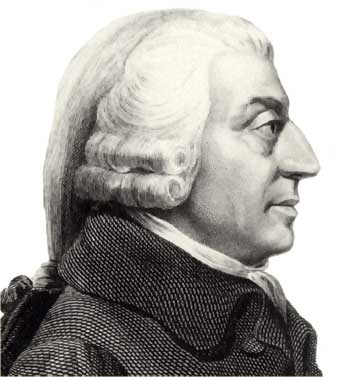
Adam Smith was born in 1723, in Scotland, is often known as the father of economics and capitalism. He is the author of “An inquiry into the nature and causes of the wealth of nations”. His “invisible hand”, “division of labour”, “management of specialization” are widely known and referred terms even.
“Of the Division of Labor”
In the first chapter of “The Wealth of Nations”, Adam Smith, explains the optimum organization of a pin factory. Traditional pin makers could produce only a few dozen pins a day. However, when organized in a factory with each worker performing a limited operation, they could produce tens of thousands a day. This was the reason why Smith favored division of labor.
He suggests that there are three causes of increase in the quantity of work:
1. Increase in dexterity in every particular workman: The division of labor reduces every man’s business to some one simple operation, and by making this operation the sole employment of his life, necessarily increases very much the dexterity of the workman.
2. Saving the time which is commonly lost in passing from one species of work to another: He suggests that it is impossible to pass very quickly from one kind of work to another that is carried on in a different place, and with quite different tools. A country weaver, who cultivates a small farm, must lose a good deal of time in passing from his loom to his field, and from the field to his loom. When the two trades can be carried on in the same workhouse, the loss of time is no doubt much less.
3. Invention of a great number of machines which facilitate and abridge labour, and enable one man to do the work of many: According to Smith, a greater part of the machines made use of in manufactures in which labor is most subdivided, were originally the inventions of common workmen, who, being each of them employed in some very simple operation, naturally turned their thoughts towards finding out easier and readier methods of performing it.
“The Invisible Hand”
Adam Smith’s famous “invisible hand” statement can be read from his original words:
“As every individual, therefore, endeavours as much as he can both to employ his capital in the support of domestick industry, and so to direct that industry that its produce may be of the greatest value; every individual necessarily labours to render the annual revenue of the society as great as he can. He generally, indeed, neither intends to promote the public interest, nor knows how much he is promoting it. By preferring the support of domestic to that of foreign industry, he intends only his own security; and by directing that industry in such a manner as its produce may be of the greatest value, he intends only his own gain, and he is in this, as in many other cases, led by an invisible hand to promote an end which was no part of his intention. Nor is it always the worse for the society that it was no part of it. By pursuing his own interest he frequently promotes that of the society more effectually than when he really intends to promote it. I have never known much good done by those who affected to trade for the public good“.
References:
-
Adam Smith, An inquiry into the nature and causes of the wealth of nations, 1776